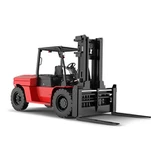


If the goods that the enterprise needs to move or the warehouse environment has environmental protection requirements such as noise or exhaust emissions, it should be considered when selecting models and configurations. If it is in cold storage or in an environment with explosion-proof requirements, the configuration of the forklift should also be cold storage or explosion-proof. Carefully inspect the places that the forklift needs to pass through during operation, and imagine possible problems, for example, whether the height of the door affects the forklift when entering and leaving the warehouse; Whether the corresponding requirements are met, etc.
When selecting the model and determining the configuration, it is necessary to describe the working conditions in detail to the forklift supplier and conduct on-site surveys to ensure that the purchased forklift fully meets the needs of the enterprise. Even if the analysis of the above steps is completed, there may still be several car models that can meet the above requirements at the same time. At this point, you need to pay attention to the following aspects:
① Different models have different working efficiencies, so the number of forklifts and drivers required are also different, which will lead to a series of cost changes. For details, see the discussion on cost in the performance evaluation part of this article.
② If forklifts are operating in the warehouse, different models require different aisle widths and different lifting capacities, which will lead to changes in the warehouse layout, such as changes in the storage volume of goods.
③ Changes in vehicle models and their quantity will have an impact on fleet management and many other aspects.
④ The market holdings of different models are different, and their after-sales support capabilities are also different. For example, the low-position driving three-way stacking forklift and the high-position driving three-way stacking forklift belong to the narrow-aisle forklift series, and both can be used in a very narrow aisle (1.5~ 2.0 meters) to complete stacking and pick-up. However, the former cab cannot be lifted, so the operating vision is poor and the work efficiency is low. Since the latter can fully cover the functions of the former, and has better performance, the sales volume of the latter in Europe is 4 to 5 times higher than that of the former, and in China it is more than 6 times. Therefore, most suppliers focus on the development of high-position driving three-way stacking forklifts, while low-position driving three-way stacking forklifts are only used in the working conditions of small tonnage and low lifting height (generally within 6 meters). When the sales volume in the market is small, the service capabilities such as the number of engineers, engineer experience, and spare parts inventory levels of its after-sales service will be relatively weak.