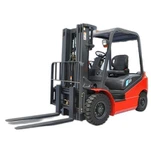


Improper forklift operation can cause serious accidents. Knowing common errors and mastering corrective measures are essential to ensure safe operation.
1. Overloading
- Incorrect operation: Transporting a heavy load that exceeds the maximum load capacity of the forklift is very dangerous. When the road surface is wet, inclined or the terrain is rough, this will make the forklift more unstable during driving. Moreover, when turning and when the load is in an up position, the load itself is not very stable. Overloading will also affect the load center and may cause the forklift to tip over.
- Corrective measures: Before operating, always understand its maximum load capacity by checking the forklift's data plate (load nameplate), which contains the load center, maximum forklift height, weight and other relevant information.
2. Speeding
- Incorrect operation: If the forklift operator is not properly trained, he may have the habit of driving the forklift at high speeds, especially when operating outdoors, which is very likely to cause safety risks.
- Corrective measures: The workplace should post visible signs in various places to warn operators and other vehicles of the permissible speeds that vehicles can travel, so as to maintain the maximum speed limit. In addition, there are speed limiting devices available on the market that can be installed on forklifts. It can reduce the maximum speed of the forklift according to the turning radius and load weight; installing a speedometer on the forklift is also a good way to make the operator aware of the speeding state.
3. The forklift is driving at a high position
- Incorrect operation: This is a common mistake made by operators. When driving, the front fork should be just below the height of the mast or keep a minimum distance from the surface above the floor. If the height of the fork is too low, even a small bump on the floor can cause danger.
- Corrective measures: The operator must strictly follow the operating specifications to control the height of the fork to ensure that the fork is at the appropriate height when driving.
4. People standing on pallets or goods during operation
- Incorrect operation:
- For example, a worker standing on a pallet to paint the indoor steel structure, the worker is likely to lose balance and fall; there are also workers standing on multiple pallets using the forklift as a ladder, which is prone to overturning.
- When the worker stands on the goods and loads them onto the pallet, if the forklift suddenly moves backward, it will cause the worker to fall.
- Corrective measures: It is strictly forbidden to stand on the pallet or cargo to perform operations. If relevant operations are required, appropriate climbing equipment should be used or the forklift should be stopped.
V. Driver standing when operating
- Incorrect operation: For example, when a forklift driver tried to stand on the starting forklift to straighten the tilted cargo on the pallet, he accidentally stepped on the tilt handle, the forklift fork tilted backward, and he was sandwiched between the fork mast and the cab.
- Corrective measures: The driver must sit in the driver's seat when the forklift is running or operating. If the cargo needs to be adjusted, the forklift should be stopped first.
VI. Sharp turn when the forklift is driving
- Incorrect operation: The forklift driver used a forklift to load two ton bags. When reversing backward, he turned the steering wheel sharply, and the forklift overturned; when the forklift was carrying cargo and driving uphill, the body of the vehicle was not straightened and turned too early, resulting in the forklift not leaving the cargo and overturning.
- Corrective measures: When the forklift is driving, the steering should be operated smoothly, especially in special situations such as forklifting goods, reversing, going uphill and downhill, etc., be prepared in advance and turn slowly.
VII. The handbrake is not pulled when the forklift is operating
- Wrong operation: If the forklift driver does not pull the handbrake, the forklift slides forward and causes injuries.
- Corrective measures: When the forklift stops operating, the driver must pull the handbrake to ensure that the vehicle is in a braking state to prevent the vehicle from slipping.
VIII. Non-standard command operation
- Wrong operation:
- A worker stood on the carriage to command the forklift to load a 12m long H-shaped steel on the vehicle. The H-shaped steel suddenly slipped from the fork and pressed the commander on the vehicle underneath.
- The forklift crushed the rainwater grate, and the pipe fell and injured the commander.
- Corrective measures: The commander should stand in a safe position to command and keep a safe distance from the forklift and the goods; when the forklift is operating, ensure the safety of the surrounding environment and avoid operating in dangerous areas (such as areas where objects may fall).
9. Improper use of forklifts (such as counterweights, etc.)
- Incorrect operation: Standing on the forks as counterweights, overturning and injury.
- Corrective measures: Never use forklifts or their components for non-standard operations, and operate them in accordance with the design purpose of the forklift.
10. Insufficient consideration of road conditions when driving forklifts
- Incorrect operation: Due to the uneven ground, the forklift driver overturned the vehicle when transporting ton bags with a single fork; the rear wheel of the forklift hit the shoulder of the road, causing the forklift to overturn.
- Corrective measures: The driver should evaluate the road conditions before operating the forklift, and drive carefully on uneven roads to avoid dangerous areas such as shoulders of the road; if the road condition is not good, the road can be repaired first or other suitable routes can be selected.